Friday, 10 October 2014

The cricket ground and the ballpark


Oriole Park at Camden Yards: a great venue for baseball
Like most from the cricket watching world, my initial view of baseball was of a game that was so far removed from cricket, an Americanisation of the bat and ball game that doesn’t come close to the complexity of the greatest sport in the world. The 2014 MLB season is the first of mine as a baseball fan. My views have changed… to an extent.

First and foremost, I am still a cricket fan. But after watching a significant number of baseball games across the long season of America’s summer game, I started to appreciate the similarities and the differences that make two games.

One similarity is the way that both games are among the few sports to resist the trend towards identikit, out of town stadia. Sure, there are a few behemoths amongst both sports, most Test grounds in Australia, the Oakland Coliseum and Tropicana Field in baseball (incidentally a common factor in some bad grounds is sharing with another sport, be it AFL or NFL).

Yet, most grounds in both sports have some kind of identity and sense of difference. I’ve found myself supporting the surprisingly successful Baltimore Orioles this season, and watching them play on the TV at Camden Yards has been fantastic, for all the little eccentricities in the ballpark, remarkable for a just twenty year old stadium. 

There’s the huge long brick building - the former B&O Warehouse, incorporated into the design rather than demolished - out in right field. You’ve got the little enclaves of seats in centre and right field, the standing area on Eutaw Street, between the stadium and the warehouse and used when the seats have sold out, and I’m sure many other foibles and charms, nooks and crannies, known to those who’ve actually been to games in the ballpark, unlike me.

There are other architecturally interesting ballparks in the league, many built in the retro-modern movement of the last twenty years. One key factor that the identikit, built to the sky stadiums of other sports miss is the sense of context. Looking to cricket, the county game has grounds which offer this context, from the cathedral at Worcester, to the sense of being enclosed by people’s homes at Hove. 

Even in the Test grounds, where they are big enough that you miss that context, you see the context of continued development. Lord’s has the spaceship of a media centre, peering over the Compton and Edrich stands, as if sneaking a glimpse of the Victorian pavillion opposite. 

If you add to this the sense of differing playing surfaces and dimensions, cricket and baseball seem ever more alike in where they conduct their games. Every cricket stadium has a different pitch and outfield, a different boundary length and shape. Ever baseball diamond has a different distance to centre field, to left and right, and amount of foul territory. 

Two games, separated by much, but also together in the fight against the featureless monolith sports stadium. 

Tuesday, 15 July 2014

Fletcher's idea comes to fruition, and Cooks protégé upstages him

Just after Duncan Fletcher took over as England coach in 1999, England’s tail reached its nadir. Caddick, Mullally, Tufnell, and Giddens. A tail with Tufnell at number ten is something poor indeed.

That stung Fletcher into action. England’s tail got slowly better, not least with use of the buddy system in which throughout Fletcher’s tenure as coach, top order batsmen were paired with tail-enders, to give them throwdowns, coach them, and eke every little bit of batting talent out them.

Paul Collingwood nudged Monty Panesar to a couple of match saving innings. Marcus Trescothick coached Matthew Hoggard into a man who, with Ashley Giles, saw England through to an Ashes Test win.

Who was Jimmy Anderson’s batting buddy? For a while it was a man who, if you squint, looks remarkably similar as a batsman, and a man who hasn’t scored as many as Anderson did at Trent Bridge since 24th May last year against New Zealand. If you hadn’t guessed yet, it’s Alastair Cook.

It must be a little bittersweet for Cook to look on. All those years of coaching Anderson and he would have some pride in his protégé, but even if he wouldn’t admit it to himself, there would jealousy that a man with not even half the batting talent of himself could show up his shortcomings even more.

Still, the two ‘broke up’ as batting buddies nearly four years ago, so this recent success can’t be credited much to Cook.

Duncan Fletcher, in his guise as tail-ender coaxer, would have a rueful grin that his system, and his emphasis on tail-end batting, while it helped India, it also benefited England even more. But, if he was watching as a neutral, he would have been proud to see that he had been part of the game that set a whole host of records for tail-end batting, including the most runs ever by 10th wicket partnerships in a match.

Anderson eventually departed nineteen short of his hundred, caught driving at Kumar, by Shikhar Dhawan at first slip. That made it two innings in a row ending in disappointment. The disappointment of departing for a 55-ball duck to lose a match with a ball to go, and missing out on becoming the first number eleven to score a Test century aren’t exactly comparable though.

Jimmy Anderson might have had a pang of disappointment on missing out, but unlike last time, there were no tears.

Tuesday, 1 July 2014

McCullum wasn’t brave by anyone except Alastair Cook’s standards

As an England fan - despite how it seemed in my last piece - it’s tempting to cast an envious glance at other countries players. In days gone by, we'd stare longingly at Shane Warne - when not cowering in fear - thinking, "Why can't we have one of those?" When we did, he was called Ian Salisbury.

Now, as I watch West Indies play New Zealand, it could be tempting wish for Trent Boult, or Tim Southee, but most of all, I'd like to scoop out Brendon McCullum's brain, liquidise it, then inject the resulting cricketing goo into Alastair Cook.

Zombification aside, McCullum gets a lot of credit, and deserves most of it.  When he declared, setting a West Indies team with a long tail  308 in at most 98 overs, but likely a lot less given the weather forecast, he got more credit than he deserved. It was the only reasonable option, of course he took it.

That decision is only brave in comparison to timid, defensive modern captaincy. What would Alastair Cook do is unlikely to become a phrase on wristbands. What would BB McCullum do may not abbreviate well (WWBBMCD), but it's a far more exciting way to live.

The only dangerous factor was Chris Gayle, but his only real attacking zeal in the series came in a calculated blast at a run chase less than half the length. Could he have tried it for a bigger target? If he had, it could have been over in one ball or after a fifty ball double century.  Still, that would have been brave.

Rewind just over a year and think back to England's Second Test win over New Zealand. That was the last time Alastair Cook got a century, but it was also the first time his captaincy was seriously questioned. Up to that point, few were enthused by his style, but 2-1 in India shut up the doubters, and captaincy wasn't the problem when all three Tests were drawn in New Zealand on deathly dull pitches.

Then he deferred a declaration for about two hours more than most judges recommended. Still, England won the match, so wasn't he 'vindicated'? Well, by being ultra-conservative England gambled with time, just as capricious an enemy as their actual opponents. They may have beaten New Zealand soundly, but with that sound beating, they shouldn't have run it so fine against time.

Until Cook grasps that setting a target isn't just about batting the opponent out of contention then declaring, nothing will change. Until he understands that sometimes a carrot must be dangled, sometimes losing may have to be risked to ensure there is enough time to win, England won't progress.

If England aren't progressing, at their current rate New Zealand may soon overtake them. As of the end of England's last Test, New Zealand were eight points behind, and that gap will close with this win over the West Indies. Brendon McCullum hasn't accumulated as many runs as Alastair Cook, but he has accumulated plaudits for his captaincy.

McCullum is a livewire in the field. Cook vegetates at first slip. McCullum makes changes often and decisively. Cook lets the game drift. McCullum has no truck with convention unless it wins him games. Cook at his most inventive is a leg-slip or a short cover.

Contrary to what I wrote earlier, I'm not sure that McCullum is a brilliant strategist a la Richie Benaud or Mike Brearley, but he is inventive and ever-changing. He reminds me of a different Essex player and England captain: Nasser Hussain.

That was a man who was brave. That was a man who led from the front. Perhaps Cook could find a mentor?

Tuesday, 24 June 2014

Sri Lanka’s annus mirabilis, and my confession

Win in Bangladesh? Sure. Win the Asia Cup? Well done! Win the World T20? FANTASTIC. Win all three series in England, including a first ever Test series win in England, off the penultimate ball of the series. Annus mirabilis beckoning.

Late June may be an early time to pass verdict on a year, but if it continues as it has gone so far, Sri Lanka’s own new era may be dawning into view. They’ve dealt with the loss of some big players in the last few years, going back to Muttiah Muralitharan. Since then, they’ve lost Dilshan at the top, Samaraweera at five, Chaminda Vaas, and Lasith Malinga. Those are all players England would love to have.

A mix of new and old pushes forward for Sri Lanka. Shaminda Eranga is a unassumingly effective seam bowler, outswing with the new ball, seam and cutters later on, and accurate to the end. Rangana Herath is both new and old, 36 years old, but enjoying his second life as a Test bowler, out from under Murali’s shadow.

Then you have Sanga and Mahela. Kumar in the form of his career; Mahela as cheeky and inventive as ever. They won’t be around for longer, but they will surely see out this fine year. They will be the hardest to replace, but there are signs that others could handle the burden.

Angelo Matthews had a fine series at number six, capped with the finest of second innings hundreds, and when Sangakkara retires, that number three position could he his. He hasn’t the technical perfection of the great man, but determination, savvy, and weight of stroke could prove an able replacement.

But enough of future changes, this fine team should remain essentially unchanged through the rest of their year. Perhaps Dimuth Karunaratne’s lack of conversion will concern, and maybe the second spinner isn’t a nailed on certainty for when they return home, but with three series to go this year, their position is strong.

The first will be another humdinger. South Africa may be recently deposed as numero uno, but they still haven’t lost an away Test series since 2006 in, guess where…. Sri Lanka. Home advantage should set up an evenly matched series.

Eight days after that series ends, Pakistan become the next challange, two Tests, Galle and Colombo, the usual drill. They’ll be just as tough as South Africa, not as good a team overall, but better suited to the conditions. But at home, with this confidence, it’s winnable.

Then there’s a wait, ten ODIs intervene, until the Test team travels again. This could be the capper to the year. New Zealand are Test cricket’s coming team, perhaps the hardest of the three series will be taking on the Black Caps. The second Test starts just into the new year, and as it concludes we shall know. Good year? Or annus mirabilis?

As I write this, a nagging thought gnaws away at my brain. All through this tour, I, an Englishman, have been supporting Sri Lanka. When Jimmy Anderson fended to Herath, I cheered and clapped and toasted the “little Sri Lankans” as Tony Greig - who if he was still with us would I’m sure too would have been secretly delighted - used to say.

It’s easy to seem condescending if I say it was simply a case of supporting the underdog, and indeed, that wouldn’t be true. It’s a mix of that, dislike for an out of touch  England cricket establishment - ECB England as Yates puts it - along with genuine love and respect for some fantastic Sri Lankan cricketers.

 Sri Lanka will retain my support for the rest of this year, as they take on South Africa, Pakistan and New Zealand. Three series wins will do for me…. no pressure.

Wednesday, 18 June 2014

Kraigg Brathwaite looks wrong

Every shot looks a bit off. The straight drive isn’t often played with a straight bat. The cover drive is played rarely, and with a lot of bottom hand. Balls are defended in varying ways. He flicks through the leg-side with a curtain-railing bat, bottom hand pulling it around. He doesn’t look like a Test match batsman.

What Brathwaite is good at however; is not getting out. That means that if he hangs around for long enough he scores runs.

At one point today, he had 9 runs off 47 balls, each one a painstakingly compiled single. Then he showed something he hadn’t previously managed to muster as a Test batsman, and rarely as a First-class one: Acceleration.

It started with a push for three down the ground, somehow managing to play it wristily through mid-off. That was off Trent Boult, but it was Mark Craig’s introduction to the attack that paid dividends for the young Bajan batsman. The off-spin of Craig, turning onto the bat of the leg-side preferring bottom hand dominant opener, was just what he needed, and a few drag downs helped even more, as 41 of his runs came off him.

You see more awkward looking shots watching Brathwaite that any other batsman outside Chanderpaul. That man is a good comparison for Brathwaite. Both are slender men who rely on touch more than anything else. Neither are beholden to the textbook, Chanderpaul in a more obvious way.

His previous innings was against Bangladesh A, and it exhibited quicker scoring than Brathwaite had ever managed before, a tally of 164 made at an impressive strike rate of 69.19. The Bangladesh bowling attack was not a threatening one, but beyond Boult and Southee, neither is New Zealand’s. Brathwaite’s new dimension is punishing the mediocre.

He identified the good, the bad and the mediocre and treated them accordingly. Boult offered the most threat, so he was neutralised for 15 runs in 49 balls, and no boundaries. Craig was dominated, and when the ball stopped swinging, Southee was attacked. Sodhi was afforded some respect, but Neesham milked like the medium pacer he is.

Brathwaite is known for his concentration, but he had a little lapse of that on 89, going into the 90s with a nick over the slips, then next ball inside-edging an expansive drive into his pads. All talk is of his mental balance, but this nervousness speaks of something else, as does a low conversion rate of 21 fifties to 7 hundreds. Does Brathwaite have a problem with the nervous nineties? Wouldn’t you if your first Test century was at hand?

Kraigg Brathwaite now had 93. A ball outside off stump guided through the slips for four… 97.

Short of a length ball from Neesham nudged down to square leg for a single. Looks composed enough... 98

Bouncer from Neesham, ducked under. Could I have had a go at that? Brathwaite refocuses… 98

Length ball pushed at, a thick edge goes through the covers. Brathwaite retains the strike. One away… 99

An impending milestone forces a change of bowler. Kane Williamson gets his first over of the day. Easy runs? That’s what McCullum wants him to think. First one… defended. Second one… defended, half a step down the track, no run there. Chat between captain and bowler, time slows down. Third one… guides one down to point, it’s there… NO! Fourth one… same shot, it is there, the tension releases as Brathwaite charges down the tack a bit quicker than he needed to. That is a Test century. Even as he should be celebrating he touched his bat in and waited for the throw, on the prospect of an unlikely second run.

He celebrated it in a low key way. Raised bat and helmet, a grin which said, “Good for a start” then back on with the game. He managed another 29 before getting caught and bowled by Trent Boult.

Kraigg Brathwaite is low key, his batting is ugly, but he has a thirst for runs, and a hunger for time at the crease. The next Shiv? Very possibly.

Tuesday, 20 May 2014

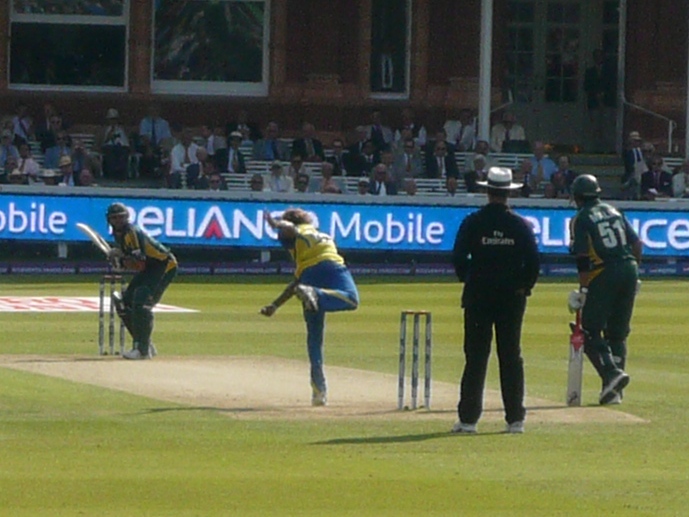
Lasith Malinga’s wide brimmed sun-hat

Slinging it at Lord's
The new T20 captain of Sri Lanka patrols the field, with a look of slight bemusement on his face and a wide-brimmed sunhat on his head. There’s an incongruity about it, a white sun-hat complimenting his blue pyjamas whilst all his charges are in blue caps.

You think of Shane Warne and his refusal to venerate the baggy green, wearing that wide-brimmed sun-hat at all times. It’s a sign of the individual, the maverick.

It also signifies a lost future for Malinga, the Test match hat worn in the limited overs game, by one of the great limited overs bowlers. But what could he have been in Tests? Thirty of them, the last in 2010, showed potential beyond most Sri Lankan seamers.

A knee injury put paid to that, and now the man with the biggest hair in cricket is over thirty, the t20 and ODI grind is the limit of his cricket.

After five overs, the sun-hat comes over, and is passed to the umpire, and Malinga starts his spell with a 65mph slower ball. Two balls later, he swings one away, Bell pokes and Thirimanne drops the dolly. It’s almost a Test match dismissal, to a Test match batsman, but not on the highest stage of all.

Another two balls later and Bell skies one to Kusal Perera, a much more limited overs dismissal, a spiralling ball caught at cover.

For anyone else, the little kiss Malinga gives the ball at the top of his mark would seem gauche and deliberately eccentric. If Dernbach did it, you’d assume he was kissing it goodbye before it sailed into the stands. But Malinga comes across as so uncomplicated, you just peg it as a good luck charm.

It didn’t bring him much luck early on, as he bamboozled England players over and again with his slower balls, only for their baffled lobs into the air to land nowhere near fielders. As an stone cold LBW appeal is turned down, he smiles at the umpire and shakes his head ruefully.

It all comes down as it often does, to his two overs at the death. A slower ball deceives Hales, then Bopara waits for one to run down to third m
an, and Hales belts one for four. Three slower balls in a row, the third going for four. What does Malinga do? He bowls a fourth, and Hales swings past it. Clean bowled.

Two more, and Malinga has bowled an entire over of slower balls. Is a slower ball a slower ball if he doesn’t bowl anything faster? Has Malinga just bowled an over of medium pace? Is that the most gutsy over of death bowling ever? Perhaps.

The next over starts with, predictably or not, another slower ball. All Malinga needs then is a two card trick against Chris Jordan, a rare quicker one then a slower cutter for the lower order basher to inside edge into his stumps.

Chris Woakes, never having faced a ball against Malinga, gets two pads in front of the stumps and somehow manages to chip a slower full-toss to mid-wicket for one, and after four singles off the nineteenth over of a T20 game, the captain rests.

Sri Lanka win. Of course they do. But 4-0-28-3 doesn’t even begin to tell the story of Lasith Malinga, his wide-brimmed sun-hat, and his over of slower balls.

Tuesday, 29 April 2014

Scout Report: John Campbell

The former West Indies U-19 opening batsman John Campbell is generally rated for his left-handed strokeplay. Indeed, he’s had a breakthrough season with the bat in the Regional 4-Day Competition for Jamaica this year, a maiden First-class fifty in his first match of the season, and a hundred in the next the highlights.

I’m not that interested in that though. His ESPNCricinfo profile talks of him as being “an aggressive left-handed batsman who likens his style of play to Chris Gayle.” That is presumably about his batting, because despite the fact that he is an off-spinner like Gayle, his off-spin is nothing like Gayle’s.

Perhaps one day he could be a genuine all-rounder, or go the Todd Astle route of transitioning from top-order batsman who bowls a bit to spinner who bats in the lower-middle order, because John Campbell’s off-spin is exciting.

His action reminds me of Graeme Swann in his early years before it tightened into the well oiled machine it became. Campbell begins his approach to the crease wide of the return crease and walks his first few steps before almost jumping across the crease to the mid-point from which he delivers.

Add that to the fact he gets close to side on and pivots well on his front foot, and there’s a legitimately good off-spin action going on. That’s not the exciting part though. The exciting part is the flight, turn and bounce he can get. Admirably for a part timer, who could be expected to dry up an end, Campbell puts plenty of flight on the ball, something which comes naturally from his orthodox action.

Add to that the most exciting part: turn and bounce. When he lands the ball on a line and length, Campbell can get the ball to grip off the surface, turn and bounce. When bowling in tandem with Jamaica’s front line spinners, Nikita Miller and Damion Jacobs, he spins the ball more than either, off the same surfaces.

All this potential has reaped some rewards. So far, in eight innings of bowling, mostly short spells, he has eight wickets, all of which came in two four-fers, one against the Leeward Islands, and the other against Combined Colleges and Campuses. Those figures of 4-17 and 4-15, to run through the middle order of the students and the tail of the Leewards, show the potential of Campbell to become a genuinely threatening front-line off-spinner.

I hope he will work on his spin bowling and try to develop into an all-rounder. There are a lot of off-spinners in the Caribbean, but few have the sort of gifts he do, and most play a patience game with impatient batsmen.

Campbell’s nowhere near the finished article yet though. As a young part-timer (for the moment) his flight and turn come with the downside of one or two bad balls an over, and opening spells with an entire over of dreck before he gets his bearings. Those aren’t big problems though. Continued practice will hone his action and leave less to go wrong. At that point the batsmen of the Caribbean can start to be worried.