Every shot looks a bit off. The straight drive isn’t often played with a straight bat. The cover drive is played rarely, and with a lot of bottom hand. Balls are defended in varying ways. He flicks through the leg-side with a curtain-railing bat, bottom hand pulling it around. He doesn’t look like a Test match batsman.
What Brathwaite is good at however; is not getting out. That means that if he hangs around for long enough he scores runs.
At one point today, he had 9 runs off 47 balls, each one a painstakingly compiled single. Then he showed something he hadn’t previously managed to muster as a Test batsman, and rarely as a First-class one: Acceleration.
It started with a push for three down the ground, somehow managing to play it wristily through mid-off. That was off Trent Boult, but it was Mark Craig’s introduction to the attack that paid dividends for the young Bajan batsman. The off-spin of Craig, turning onto the bat of the leg-side preferring bottom hand dominant opener, was just what he needed, and a few drag downs helped even more, as 41 of his runs came off him.
You see more awkward looking shots watching Brathwaite that any other batsman outside Chanderpaul. That man is a good comparison for Brathwaite. Both are slender men who rely on touch more than anything else. Neither are beholden to the textbook, Chanderpaul in a more obvious way.
His previous innings was against Bangladesh A, and it exhibited quicker scoring than Brathwaite had ever managed before, a tally of 164 made at an impressive strike rate of 69.19. The Bangladesh bowling attack was not a threatening one, but beyond Boult and Southee, neither is New Zealand’s. Brathwaite’s new dimension is punishing the mediocre.
He identified the good, the bad and the mediocre and treated them accordingly. Boult offered the most threat, so he was neutralised for 15 runs in 49 balls, and no boundaries. Craig was dominated, and when the ball stopped swinging, Southee was attacked. Sodhi was afforded some respect, but Neesham milked like the medium pacer he is.
Brathwaite is known for his concentration, but he had a little lapse of that on 89, going into the 90s with a nick over the slips, then next ball inside-edging an expansive drive into his pads. All talk is of his mental balance, but this nervousness speaks of something else, as does a low conversion rate of 21 fifties to 7 hundreds. Does Brathwaite have a problem with the nervous nineties? Wouldn’t you if your first Test century was at hand?
Kraigg Brathwaite now had 93. A ball outside off stump guided through the slips for four… 97.
Short of a length ball from Neesham nudged down to square leg for a single. Looks composed enough... 98
Bouncer from Neesham, ducked under. Could I have had a go at that? Brathwaite refocuses… 98
Length ball pushed at, a thick edge goes through the covers. Brathwaite retains the strike. One away… 99
An impending milestone forces a change of bowler. Kane Williamson gets his first over of the day. Easy runs? That’s what McCullum wants him to think. First one… defended. Second one… defended, half a step down the track, no run there. Chat between captain and bowler, time slows down. Third one… guides one down to point, it’s there… NO! Fourth one… same shot, it is there, the tension releases as Brathwaite charges down the tack a bit quicker than he needed to. That is a Test century. Even as he should be celebrating he touched his bat in and waited for the throw, on the prospect of an unlikely second run.
He celebrated it in a low key way. Raised bat and helmet, a grin which said, “Good for a start” then back on with the game. He managed another 29 before getting caught and bowled by Trent Boult.
Kraigg Brathwaite is low key, his batting is ugly, but he has a thirst for runs, and a hunger for time at the crease. The next Shiv? Very possibly.
Wednesday, 18 June 2014

Tuesday, 20 May 2014
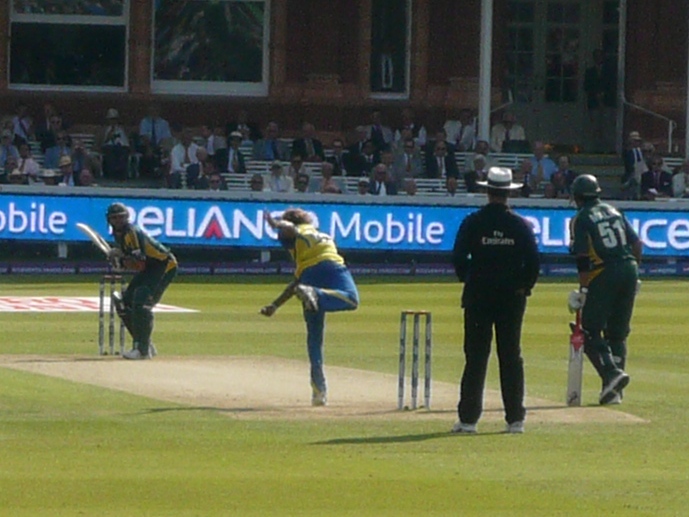
Lasith Malinga’s wide brimmed sun-hat
 |
| Slinging it at Lord's |
You think of Shane Warne and his refusal to venerate the baggy green, wearing that wide-brimmed sun-hat at all times. It’s a sign of the individual, the maverick.
It also signifies a lost future for Malinga, the Test match hat worn in the limited overs game, by one of the great limited overs bowlers. But what could he have been in Tests? Thirty of them, the last in 2010, showed potential beyond most Sri Lankan seamers.
A knee injury put paid to that, and now the man with the biggest hair in cricket is over thirty, the t20 and ODI grind is the limit of his cricket.
After five overs, the sun-hat comes over, and is passed to the umpire, and Malinga starts his spell with a 65mph slower ball. Two balls later, he swings one away, Bell pokes and Thirimanne drops the dolly. It’s almost a Test match dismissal, to a Test match batsman, but not on the highest stage of all.
Another two balls later and Bell skies one to Kusal Perera, a much more limited overs dismissal, a spiralling ball caught at cover.
For anyone else, the little kiss Malinga gives the ball at the top of his mark would seem gauche and deliberately eccentric. If Dernbach did it, you’d assume he was kissing it goodbye before it sailed into the stands. But Malinga comes across as so uncomplicated, you just peg it as a good luck charm.
It didn’t bring him much luck early on, as he bamboozled England players over and again with his slower balls, only for their baffled lobs into the air to land nowhere near fielders. As an stone cold LBW appeal is turned down, he smiles at the umpire and shakes his head ruefully.
It all comes down as it often does, to his two overs at the death. A slower ball deceives Hales, then Bopara waits for one to run down to third m
an, and Hales belts one for four. Three slower balls in a row, the third going for four. What does Malinga do? He bowls a fourth, and Hales swings past it. Clean bowled.
Two more, and Malinga has bowled an entire over of slower balls. Is a slower ball a slower ball if he doesn’t bowl anything faster? Has Malinga just bowled an over of medium pace? Is that the most gutsy over of death bowling ever? Perhaps.
The next over starts with, predictably or not, another slower ball. All Malinga needs then is a two card trick against Chris Jordan, a rare quicker one then a slower cutter for the lower order basher to inside edge into his stumps.
Chris Woakes, never having faced a ball against Malinga, gets two pads in front of the stumps and somehow manages to chip a slower full-toss to mid-wicket for one, and after four singles off the nineteenth over of a T20 game, the captain rests.
Sri Lanka win. Of course they do. But 4-0-28-3 doesn’t even begin to tell the story of Lasith Malinga, his wide-brimmed sun-hat, and his over of slower balls.
Tuesday, 29 April 2014
Scout Report: John Campbell
The former West Indies U-19 opening batsman John Campbell is generally rated for his left-handed strokeplay. Indeed, he’s had a breakthrough season with the bat in the Regional 4-Day Competition for Jamaica this year, a maiden First-class fifty in his first match of the season, and a hundred in the next the highlights.
I’m not that interested in that though. His ESPNCricinfo profile talks of him as being “an aggressive left-handed batsman who likens his style of play to Chris Gayle.” That is presumably about his batting, because despite the fact that he is an off-spinner like Gayle, his off-spin is nothing like Gayle’s.
Perhaps one day he could be a genuine all-rounder, or go the Todd Astle route of transitioning from top-order batsman who bowls a bit to spinner who bats in the lower-middle order, because John Campbell’s off-spin is exciting.
His action reminds me of Graeme Swann in his early years before it tightened into the well oiled machine it became. Campbell begins his approach to the crease wide of the return crease and walks his first few steps before almost jumping across the crease to the mid-point from which he delivers.
Add that to the fact he gets close to side on and pivots well on his front foot, and there’s a legitimately good off-spin action going on. That’s not the exciting part though. The exciting part is the flight, turn and bounce he can get. Admirably for a part timer, who could be expected to dry up an end, Campbell puts plenty of flight on the ball, something which comes naturally from his orthodox action.
Add to that the most exciting part: turn and bounce. When he lands the ball on a line and length, Campbell can get the ball to grip off the surface, turn and bounce. When bowling in tandem with Jamaica’s front line spinners, Nikita Miller and Damion Jacobs, he spins the ball more than either, off the same surfaces.
All this potential has reaped some rewards. So far, in eight innings of bowling, mostly short spells, he has eight wickets, all of which came in two four-fers, one against the Leeward Islands, and the other against Combined Colleges and Campuses. Those figures of 4-17 and 4-15, to run through the middle order of the students and the tail of the Leewards, show the potential of Campbell to become a genuinely threatening front-line off-spinner.
I hope he will work on his spin bowling and try to develop into an all-rounder. There are a lot of off-spinners in the Caribbean, but few have the sort of gifts he do, and most play a patience game with impatient batsmen.
Campbell’s nowhere near the finished article yet though. As a young part-timer (for the moment) his flight and turn come with the downside of one or two bad balls an over, and opening spells with an entire over of dreck before he gets his bearings. Those aren’t big problems though. Continued practice will hone his action and leave less to go wrong. At that point the batsmen of the Caribbean can start to be worried.
I’m not that interested in that though. His ESPNCricinfo profile talks of him as being “an aggressive left-handed batsman who likens his style of play to Chris Gayle.” That is presumably about his batting, because despite the fact that he is an off-spinner like Gayle, his off-spin is nothing like Gayle’s.
Perhaps one day he could be a genuine all-rounder, or go the Todd Astle route of transitioning from top-order batsman who bowls a bit to spinner who bats in the lower-middle order, because John Campbell’s off-spin is exciting.
His action reminds me of Graeme Swann in his early years before it tightened into the well oiled machine it became. Campbell begins his approach to the crease wide of the return crease and walks his first few steps before almost jumping across the crease to the mid-point from which he delivers.
Add that to the fact he gets close to side on and pivots well on his front foot, and there’s a legitimately good off-spin action going on. That’s not the exciting part though. The exciting part is the flight, turn and bounce he can get. Admirably for a part timer, who could be expected to dry up an end, Campbell puts plenty of flight on the ball, something which comes naturally from his orthodox action.
Add to that the most exciting part: turn and bounce. When he lands the ball on a line and length, Campbell can get the ball to grip off the surface, turn and bounce. When bowling in tandem with Jamaica’s front line spinners, Nikita Miller and Damion Jacobs, he spins the ball more than either, off the same surfaces.
All this potential has reaped some rewards. So far, in eight innings of bowling, mostly short spells, he has eight wickets, all of which came in two four-fers, one against the Leeward Islands, and the other against Combined Colleges and Campuses. Those figures of 4-17 and 4-15, to run through the middle order of the students and the tail of the Leewards, show the potential of Campbell to become a genuinely threatening front-line off-spinner.
I hope he will work on his spin bowling and try to develop into an all-rounder. There are a lot of off-spinners in the Caribbean, but few have the sort of gifts he do, and most play a patience game with impatient batsmen.
Campbell’s nowhere near the finished article yet though. As a young part-timer (for the moment) his flight and turn come with the downside of one or two bad balls an over, and opening spells with an entire over of dreck before he gets his bearings. Those aren’t big problems though. Continued practice will hone his action and leave less to go wrong. At that point the batsmen of the Caribbean can start to be worried.
Tuesday, 15 April 2014
Can Pollard play Test cricket?
If Viv Richards emerged from Antigua today, flaying boundaries all round the ground with insouciant ease, and chomping on his gum, would he be pigeonholed as a t20 player? It’s an interesting question to ask, and one that doesn’t have an easy answer.
Kieron Pollard is no Viv Richards, but he’s something. He has a little of the insouciance, a lot of the power (albeit with bigger bats and smaller boundaries) and perhaps even greater fielding ability. Add in some useful medium pace somewhere in the Angelo Mathews category that looks like it should be faster than it is, and you’ve got yourself a potent short form cricketer.
The next question though, is can he play Test cricket? That’s debatable. Look at his First-class stats and you say there’s no reason he can’t. In 24 games spread over six years, the last a year ago, he averages a respectable 38.40 in a West Indies regional setup where few average over forty.
What may end up being the problem is Pollard’s attitude towards getting into the Test team. If you read an interview with him from a couple of weeks ago he says that “I'm highly unlikely to play a full season of first-class cricket, so my only way of playing is by performing well in the ODIs.”
If you look at it from one angle, it makes sense, Pollard’s an international player, and the ODIs and T20s versus Ireland and England, along with the World T20 made it “highly unlikely” for him to play a full season of First-class cricket. It doesn’t mean he can’t play some though.
Some means more than two. That’s all he’s managed in the current Regional 4-Day Competition season. In those two, he managed scores of 4, 111, and 0. A fourth First-class hundred adds fuel to the fire, and adds to his case of playing Test cricket. But the IPL beckons, so he’s off, and won’t play First-class cricket for another year.
Why can’t he forgo the IPL for a year to play some county cricket? If he put feelers out there, I’m sure he could find a county to play for during at least part of the English summer. The point is, if he wants to play First-class cricket, he’s a good enough player, and well known enough to make it happen.
Twenty four First-class matches isn’t enough to play Test cricket. If he plays some regional cricket, a couple of months of the county season, that number could go up a fair bit. The weakness of the West Indies’ batting reserves is such that three or four more hundreds could secure him the number six spot with some haste.
He just needs to play those matches, and prove he can be a First-class cricketer. To make the Viv comparison again, the great man had played 44 First-class matches before he became a Test cricketer. At that point he had more runs at 2285, but at a lower average of 32.18, and one less hundred that Pollard has at this point.
Nobody’s suggesting Pollard could become anything near the great Viv, but a couple of thousand Test runs averaging around 35 to 40 batting at number six seems well within his grasp. If you add a bit of bowling, and great fielding to that, he doesn’t look a bad package to have coming in at six. If you compare him the current number six, from West Indies’ last Test in New Zealand, Narsingh Deonarine, he represents a significant potential increase. If only he’d make the effort.
Tuesday, 25 March 2014
Brathwaite and Chanderpaul
If you think of Caribbean batting, your mind goes to IVA Richards, to Gordon Greenidge and into the present day, to the likes of Kieron Pollard, and Darren Bravo. Power players, stylists, never dull. Maybe dull is what the West Indies need in their Test cricket.
Look forward four or five years, and it would not be too much of a stretch to see Tagenarine Chanderpaul and Kraigg Brathwaite opening together in Test matches. Both are players who many would find dull. Scratch that, their batting is dull. So far this season Brathwaite has a strike-rate in First-class cricket of 29.52, and Chanderpaul has 22.05.
“Don’t run before you can walk” goes the cliche. Other sayings make the same point, “Don’t put the horse before the cart”, for example. They may have been used beyond all useful purpose, but the meaning remains somewhere. Build things in the proper order.
For these two young batsmen it means that a solid defensive technique comes first. Brathwaite has faced 718 balls, more than any other batsman in the competition, in six innings so far this season, facing an average of 119.66 balls per innings. Chanderpaul has been similarly good in terms of crease occupation, facing 645 balls, in six innings, an average of 107.5 balls an innings.
Those are occupation rates comparable to the best in Test cricket. The two youngsters have taken a strange approach in the modern game: they’re First-class specialists. At the age of 21, Brathwaite’s already played 49 First-class games. That includes ten Test matches, and is accompanied by 12 List A games, but strikingly, not a single T20. Chanderpaul junior has six First-class games under his belt at the age of 17, and nothing else at the senior level.
What both need to do now is add extra dimensions to their games. Brathwaite may be Chris Gayle’s opening partner when next the West Indies are in whites, and a better player to open with if you struggle to move the score along could not be found. Still, if both are to open together when Gayle is gone, they’re going to have to add more shots.
Perhaps it’s time for both of them, especially Brathwaite, on the verge of Test cricket, to play more one day cricket, and maybe even some T20, to give them a way to develop shots. Both need to drill into themselves the balls that they need to put away, the short wide ones, the half-volleys on leg stump.
If they take the bad balls they’re give and put them away that should help both players convert their scores. It’s less of a problem for Brathwaite, he has five First-class centuries, and 19 fifties, but that conversion rate could do with being higher, and that will only happen if Brathwaite can start cashing in properly once he’s fully in, something he doesn’t really do so far in his career.
So far this season he has two fifties, but they both should have been converted into hundreds, rather than ending at 82 against Windward Islands and 91 against Combined Colleges and Campuses.
Chanderpaul has had a similar problem, but more acute. So far, in each match so far this season he’s made it to forty, but he hasn’t converted one of those into his maiden First-class fifty.
They’ve been hampered by the sort of pitches, and bowling they’ve received. The pitches don’t encourage bowlers to pitch the ball up, and the slowness means when they do, driving is hazardous. You’re more likely to see runs coming from full blooded cuts and pulls, shots natural to neither player.
Both need to find a couple of attacking shots to depend on. Alastair Cook makes a good role model for this method. For five or six years in Test cricket, Cook barely drove. Instead, he waited for the bowlers to err in line or length, to cut, pull and nudge them into exasperation.
If these two can find two or three shots to depend on, they can maintain a strike rate of forty or fifty, enough to keep the pressure off them and keep the scoreboard ticking. That’s all you need to be a Test opener of the old school. That’s what the West Indies need.
Sunday, 23 March 2014
The Steve O’Keefe story
 |
| O'Keefe: more than meets the eye |
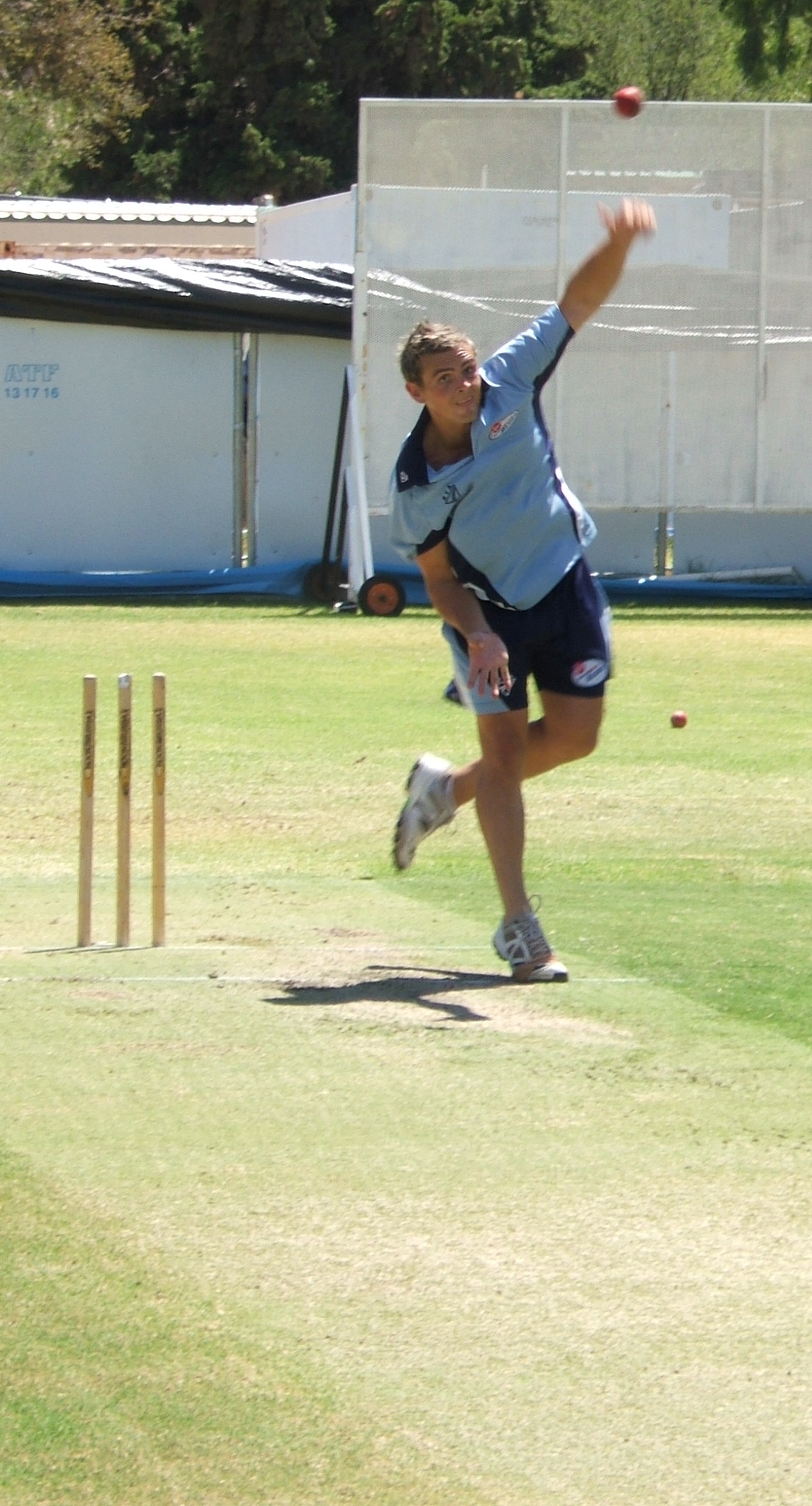
A while ago, before the Ashes series in England, I wrote a piece (never actually posted) asking who could get in the Australian team ahead of O’Keefe, with various serious options eventually devolving into Clarrie Grimmett’s ghost and various other fatuous suggestions. The point being that O’Keefe had several seasons of being the best spinner in the Sheffield Shield, but fell short of a Test place as Australia tried almost everyone else conceivable.
Maybe he’s just too still. Most of my arguments towards O’Keefe being near the Test team have been down to statistics, but watch him live, and he’s a fairly unfashionable sort of player. He ambles up to the crease, and rolls through it, hurling the ball at the batsman’s pads.
Watch him for a spell though, and those still waters start to deepen. Some balls get tossed up, some get fired in, but he’s relentless and accurate. The position on the crease changes, the pace, line and length all change, over and over again, so the batsman can never get into a rhythm against him. O’Keefe is like Rangana Herath, not much cop on first glance, but relentless and inventive.
If you watch the bowling of a left-arm spinner on the other side, playing for the Alcohol. Think Again Western Warriors (Western Australia to you and me), faster waters run shallower. Ashton Agar has a wonderful action, the sort of action that prompts Australian selectors to give him a Test match debut at 19. But what does that action harvest for him? 55 wickets at 41.03 so far.
When Agar gets into a rhythm, so does the batsman, blocking him away over and over, pausing only to put away the odd bad ball. When O’Keefe does, he dances to his own drumbeat, faster or slower, almost imperceptibly to the batsman; kept constantly alert. Neither players get big turn, but O’Keefe uses what he gets more intelligently.
His continued non-selection for Australia could tell you many things about the mindset of their selectors, if you were that way inclined. You could use it to paint a picture of distrust of statistics, a commitment to instinct, and a love of aesthetic quality. You could make that argument again if you looked at the relative treatment of Shaun Marsh and Phillip Hughes.
But it’s not confined to them. There have always been unfashionable players. In England, the likes of David Masters and Alan Richardson have piled up County Championship wickets, without the sniff of an England place. A lack of pace, actions not pleasing to the eye, and age counting against the tangible achievements.
The charge levelled against these sort of players is that they haven’t got what’s necessary to play at a higher level. That argument seems to suggest that there’s a cookie-cutter set of skills needed for Test cricket, ignoring the wide variety of different players who've made the step up.
O’Keefe’s moment, if it ever came, has probably passed now. When Nathan Lyon made his Test debut, O’Keefe was the obvious choice, but was passed over. He’ll just have to be satisfied with seven T20 internationals for his country, a superficial selection because he looked like a T20 spinner. Those waters ran deeper than the selectors knew; he should have been a Test spinner.
Friday, 21 March 2014
Will there ever be another great leg-spinner?
Bryce McGain, Steve Smith, Cameron White, Scott Borthwick, Amit Mishra, Todd Astle, Ish Sodhi, Imran Tahir, Devendra Bishoo.
Can you see where I’m going with this? That’s the complete list of front-line leg-spinners to have debuted in Test cricket since Shane Warne retired at the beginning of 2007. Add all their figures together and they have 149 wickets at 44.82. It’s fair to say we’re going through a leg-spin drought at the moment.
You can write off Warne as a complete one off. But how would that explain Stuart MacGill, or Anil Kumble. They both held their own, hell, in any other era they each would have been the best leg-spinner in the world.
What Warne and MacGill (and to an extent Kumble, though he had other gifts) did which pushed them above other leg-spinners of the era was rip the ball finger-chafing hard, in Warne’s case with astounding control. Do any of the leg-spinners mentioned above rip the ball that hard? Perhaps only Steve Smith, himself just a part timer these days can match that level of spin, but without the control, he can never be a front-liner.
Big spin is more important than ever before. With bats as big as they are, and boundaries pulled in to postage stamp dimensions, spinners have a harder job than they ever have before. In the last five years or so, three spinners - none of whom are leg-spinners - have dominated the scene.
Graeme Swann did it by ripping the ball harder than the vast majority of finger-spinners, using an unorthodox tight grip, ball pushed back into the second joints in his fingers. He also preyed on a historical preponderance of left-handers, ripping the ball past their outside edge, before drifting it into their pads.
Saeed Ajmal did it with his doosra. Just enough turn to beat the outside and inside edges was allied to a keen mind, using his doosra sparingly or extravagantly, teasing the batsman with the possibility of it, or dumbfounding them with the reality.
Rangana Herath did it with guile, enough spin on helpful pitches and the willingness and accuracy to wait over after over, stalking the victim, probing away for a weakness, striking when he found it. Given a superlative straighter ball, and the occasional carrom ball; small variations added up to a lot.
So what does that tell the young leg-spinner? Well for one, right arm leg-spinners can combine taking the ball away from right handers with big turn that should make them indispensable in this modern age. Why isn’t it?
The ever present one bad ball an over may be two or three with young leg-spinners, and if you’re going to nurture them you have to accept that. But in days gone by, those balls may have gone for four, even one if a sweeper is posted. Now with railway sleepers in their hands, batsmen can pummel the smallest error in length all the way over the mid-wicket fence. Bowlers need to spin it harder to survive, but make less errors than ever before. That’s a tough mix.
If you look at the list at the beginning of this article, the future looks fairly grim. None of the three Australians have a chance in hell of being picked as a front-line spinner again, and in the case of Cameron White, should never have been in the first place.
Amit Mishra and Imran Tahir are two leggies whose main weapons are their googlies. They’ve also both been tried and discarded at Test level, with little chance of a sustained run in the team in the future.
Todd Astle has been replaced by another leggie in Ish Sodhi, and it’s Sodhi, Scott Borthwick and Devendra Bishoo who have the best chance of these players to cement a place in their respective countries teams.
New Zealand have shown patience with Sodhi after a less than stellar start, and as long as Vettori is unavailable, his place in the team looks secure for the moment. Borthwick is the man in possession in the England team, but when they come up against Sri Lanka in June, that may matter for little.
It can’t help him that he plays as a number three bat for his county side Durham, but England’s lack of many other options may help him retain his place. Bishoo has a few men to fight past, and isn’t putting up the outstanding numbers in the domestic competition which would demand his recall.
Only Sodhi gives the hope of being one of the great spinners of his era. If not him, the next great leg-spinner, the next Warne, might be the next Qadir instead, keeping a dying art alive. Maybe he might be a Qadir, Abdul’s son Usman having shown some promise at the art.
We’ll just have to wait. We don’t know what he looks like yet. He may be tall and bespectacled like Anil Kumble. He might be small and gnomish like Clarrie Grimmett. Whoever he is, to paraphrase How I Met Your Mother: “He’s getting here as fast as he can.”
Can you see where I’m going with this? That’s the complete list of front-line leg-spinners to have debuted in Test cricket since Shane Warne retired at the beginning of 2007. Add all their figures together and they have 149 wickets at 44.82. It’s fair to say we’re going through a leg-spin drought at the moment.
You can write off Warne as a complete one off. But how would that explain Stuart MacGill, or Anil Kumble. They both held their own, hell, in any other era they each would have been the best leg-spinner in the world.
What Warne and MacGill (and to an extent Kumble, though he had other gifts) did which pushed them above other leg-spinners of the era was rip the ball finger-chafing hard, in Warne’s case with astounding control. Do any of the leg-spinners mentioned above rip the ball that hard? Perhaps only Steve Smith, himself just a part timer these days can match that level of spin, but without the control, he can never be a front-liner.
Big spin is more important than ever before. With bats as big as they are, and boundaries pulled in to postage stamp dimensions, spinners have a harder job than they ever have before. In the last five years or so, three spinners - none of whom are leg-spinners - have dominated the scene.
Graeme Swann did it by ripping the ball harder than the vast majority of finger-spinners, using an unorthodox tight grip, ball pushed back into the second joints in his fingers. He also preyed on a historical preponderance of left-handers, ripping the ball past their outside edge, before drifting it into their pads.
Saeed Ajmal did it with his doosra. Just enough turn to beat the outside and inside edges was allied to a keen mind, using his doosra sparingly or extravagantly, teasing the batsman with the possibility of it, or dumbfounding them with the reality.
Rangana Herath did it with guile, enough spin on helpful pitches and the willingness and accuracy to wait over after over, stalking the victim, probing away for a weakness, striking when he found it. Given a superlative straighter ball, and the occasional carrom ball; small variations added up to a lot.
So what does that tell the young leg-spinner? Well for one, right arm leg-spinners can combine taking the ball away from right handers with big turn that should make them indispensable in this modern age. Why isn’t it?
The ever present one bad ball an over may be two or three with young leg-spinners, and if you’re going to nurture them you have to accept that. But in days gone by, those balls may have gone for four, even one if a sweeper is posted. Now with railway sleepers in their hands, batsmen can pummel the smallest error in length all the way over the mid-wicket fence. Bowlers need to spin it harder to survive, but make less errors than ever before. That’s a tough mix.
If you look at the list at the beginning of this article, the future looks fairly grim. None of the three Australians have a chance in hell of being picked as a front-line spinner again, and in the case of Cameron White, should never have been in the first place.
Amit Mishra and Imran Tahir are two leggies whose main weapons are their googlies. They’ve also both been tried and discarded at Test level, with little chance of a sustained run in the team in the future.
Todd Astle has been replaced by another leggie in Ish Sodhi, and it’s Sodhi, Scott Borthwick and Devendra Bishoo who have the best chance of these players to cement a place in their respective countries teams.
New Zealand have shown patience with Sodhi after a less than stellar start, and as long as Vettori is unavailable, his place in the team looks secure for the moment. Borthwick is the man in possession in the England team, but when they come up against Sri Lanka in June, that may matter for little.
It can’t help him that he plays as a number three bat for his county side Durham, but England’s lack of many other options may help him retain his place. Bishoo has a few men to fight past, and isn’t putting up the outstanding numbers in the domestic competition which would demand his recall.
Only Sodhi gives the hope of being one of the great spinners of his era. If not him, the next great leg-spinner, the next Warne, might be the next Qadir instead, keeping a dying art alive. Maybe he might be a Qadir, Abdul’s son Usman having shown some promise at the art.
We’ll just have to wait. We don’t know what he looks like yet. He may be tall and bespectacled like Anil Kumble. He might be small and gnomish like Clarrie Grimmett. Whoever he is, to paraphrase How I Met Your Mother: “He’s getting here as fast as he can.”
Subscribe to:
Posts (Atom)